For years, career advice followed a simple formula. Earn a degree, gain experience, and return to school whenever you want to move ahead. Today, that path is no longer guaranteed.
Many employers now value practical skills as much as academic qualifications. A 2024 Pew survey found that around half of Americans believe a four-year degree matters less today than it did 20 years ago. Forbes also reports that companies like Apple, IBM, and Hilton have removed degree requirements for many roles. They now focus more on experience and proven abilities.
This shift does not mean education has lost its value. It means every learning decision should support a clear career goal. The professionals who grow the fastest build skills with purpose. They do not collect qualifications simply because they look impressive.
Start With the Career You Want
Many people begin by asking which degree they should pursue next. That approach makes sense at first, but it often results in the wrong choice.
Instead, start by defining the role you want five or ten years from now. Then work backward. Study job descriptions for that position. Talk to people already doing the work. Look at the skills employers expect instead of assuming another degree is the answer.
Having a career roadmap matters more than sticking to a childhood dream. Research from Education and Employers found that more than half of adults now work in careers unrelated to what they wanted as children. The study also found that 72% lacked a good understanding of career opportunities when they were younger. Another 44% wished they had been exposed to more career options.
Once you discover work that genuinely interests you, learning becomes much easier. You are more likely to build new skills with enthusiasm and stay motivated, even when work becomes stressful. Education should support the career you want, not become the career goal itself.
Match Your Learning to Your Long-Term Goals
Every advanced degree serves a different purpose. Choosing one without understanding that purpose can cost years of effort.
An MBA, for example, helps professionals strengthen leadership and management skills. However, some experienced leaders eventually want to move beyond managing teams. They want to solve complex business challenges, influence strategy, or contribute new ideas to their industry.
That is where a Doctor of Business Administration, or DBA, fits naturally. Unlike a traditional PhD, which focuses mainly on theoretical research, a DBA emphasizes practical knowledge, Saint Leo University notes. Candidates investigate real organizational problems and develop solutions that businesses can apply.
Interest in DBA programs continues to grow. According to The European, 86% of institutions offering DBAs expect enrollment to increase. Global demand for DBA programs has also risen by 80%. Moreover, the availability of a DBA online degree has further expanded access. Professionals can deepen their expertise while continuing to work full-time.
The bigger lesson is simple. Do not choose a qualification because it sounds prestigious. Choose one because it supports the career you want to build.
Consider the Cost of Time Along With the Cost of Tuition
Most people compare tuition fees before choosing a program. They often overlook something even more valuable. That is their time.
A degree may take several years to complete. During that period, you could gain leadership experience, build industry connections, earn promotions, or learn specialized skills. Those opportunities deserve careful consideration.
Former Google executive Jad Tarifi recently raised this issue while discussing AI. He said that technology is evolving so quickly that some lengthy degree programs may struggle to keep pace. He believes many professionals would benefit more from studying specialized areas connected to AI. Others may gain more through practical experience than through another traditional degree.
His comments will not apply to every career. However, they highlight an important question. Will the qualification still deliver the value you expect by the time you finish it?
Looking beyond tuition helps you make a smarter decision. The best investment balances money, time, and future career opportunities.
Build Skills That Stay Valuable in an AI-Driven Workplace
Technology will continue to reshape the workplace. That makes adaptable skills more important than ever.
According to CNBC, career experts expect several human skills to become even more valuable during the next five years. These include critical thinking, communication, emotional intelligence, adaptability, and AI literacy. These abilities help professionals succeed even as technology continues to improve.
AI can process information quickly. It cannot replace sound judgment, strong relationships, or thoughtful decision-making. Employers still need people who can solve difficult problems and communicate with confidence.
This is why learning should never stop after graduation. You can strengthen these skills through new projects, leadership opportunities, mentoring, and continuous professional development. They remain valuable regardless of your industry or job title.
Professionals who combine technical knowledge with strong human skills will be better prepared for whatever changes come next.
FAQs
How do I choose what career I want?
Start by identifying the work that genuinely interests you and matches your strengths. Research different roles and speak with professionals already in those fields. Then compare the required skills with your current abilities and create a learning plan that supports your long-term goals.
Is DBA better than MBA?
Neither degree is better in every situation. An MBA is designed to strengthen leadership and management skills, while a DBA focuses on solving complex business problems through applied research. The right choice depends on your career goals and professional experience.
How can I AI-proof my career?
Focus on skills that technology cannot easily replace. Strengthen critical thinking, communication, emotional intelligence, adaptability, and problem-solving while learning to work effectively with AI. Continuous learning and practical experience will help you stay competitive as industries continue to evolve.
Career Insights by the Numbers
| Statistic | Why It Matters |
|---|---|
| ~50% say a four-year degree matters less today than 20 years ago. | Skills are becoming as important as qualifications. |
| 50%+ changed career paths; 72% lacked career awareness; 44% wanted more career exposure. | A clear career roadmap leads to better decisions. |
| 86% of DBA providers expect enrollment growth. | Interest in DBA programs is rising. |
| 80% growth in global DBA demand. | More professionals are pursuing advanced business education. |
Build a Career Strategy Instead of Collecting Credentials
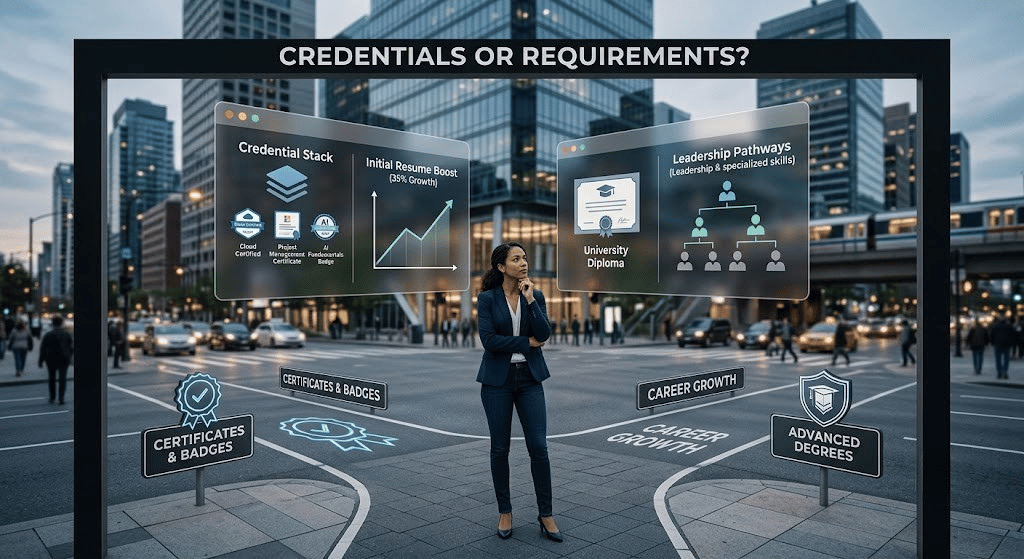
A qualification should always support a larger career plan. It should never become the plan itself. Sometimes another degree is the right decision. Other times, a certification, new role, or hands-on experience creates greater value. The best choice depends on your goals, your industry, and where you want your career to go.
Before committing to another qualification, ask yourself a few simple questions. Will employers value it? Will it help you reach your next career milestone? Could another path produce the same result more quickly?
Those answers often provide more clarity than rankings or marketing brochures.
Career growth rarely comes from collecting certificates. It comes from making thoughtful learning decisions that move you closer to the professional you want to become.