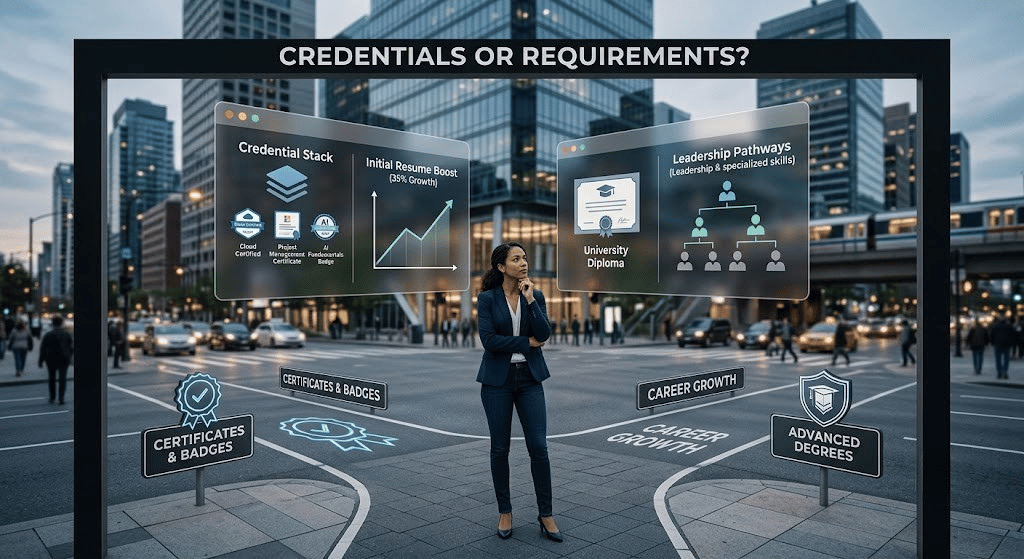
Learning has become a career strategy. Every year, professionals invest in new certifications, graduate degrees, and online courses to stay competitive. At the same time, the way employers assess candidates is evolving.
Some industries prioritize practical skills, while others still require formal education for career advancement. As a result, one question has become more important than ever.
Are you earning a credential that helps you stand out, or one that's actually required for the career you want? The answer isn't always obvious. A certificate might strengthen your résumé, while a graduate degree could unlock leadership positions that would otherwise remain out of reach.
Understanding the difference between career credentials and career requirements helps you make smarter decisions about your time, money, and future.
Not Every Credential Creates the Same Career Value
Non-degree credentials (NDCs) have become a major part of today's workforce. Badges, certificates, certifications, and microcredentials offer faster and often more affordable ways to develop new skills. There are now more than 1.5 million unique non-degree credentials in the United States. The number appearing on workers' résumés has grown by nearly 35% in just one year.
That growth reflects changing hiring practices, but research shows these credentials are not interchangeable. Professional certifications often deliver stronger long-term returns. They usually require exams, third-party validation, and periodic renewal. Their impact is greatest when they directly relate to your job.
In contrast, badges and certificates often provide an initial boost when first earned. However, accumulating more of them doesn't necessarily increase earnings or career opportunities.
Employers clearly recognize the value of practical learning. According to Fortune, 86% of employers say certificates demonstrate real job readiness. However, job readiness and career progression are not always the same thing. A credential may help you land a position, but it may not qualify you for leadership roles later in your career.
Some Careers Still Depend on Formal Education
Technology has made many careers more skill-driven than degree-driven. Fields such as software development, digital marketing, and graphic design increasingly reward portfolios, experience, and demonstrated ability over academic credentials.
Other professions operate differently because they involve public responsibility, regulation, or organizational leadership.
Take healthcare as an example. A registered nurse who wants to specialize needs formal education and clinical training. Physicians also complete additional education to pursue medical specialties.
Higher education follows a similar path. As colleges navigate faculty shortages, AI adoption, student mental health, and inclusion, leadership roles require professionals with expertise in both educational practice and institutional management.
For professionals pursuing those responsibilities, a Doctorate in Higher Education often becomes more than another credential, American International College notes. It prepares future educational leaders to improve student outcomes, shape institutional policies, manage organizational change, and foster student-centered campus communities.
Many professionals also choose EdD in Higher Education online programs because they can continue working while developing the leadership skills their future roles demand. In this situation, the degree is no longer about collecting another qualification. It becomes preparation for a very specific career path.
Match Your Education to Your Career Goals
Many people assume the highest degree automatically leads to the best opportunities. The job market doesn't always work that way.
Over the past 25 years, the number of doctoral students has more than doubled worldwide. Yet permanent academic positions have not kept pace. Today, fewer than 20% of PhD graduates secure long-term academic jobs, even though many begin their studies expecting one.
The landscape is becoming even more competitive. According to Forbes, leading PhD programs are admitting fewer students. International applicants are increasingly choosing other countries for graduate study. Researchers are also leaving federal agencies, creating uncertainty across academic careers.
This doesn't mean advanced degrees have lost their value. It means every educational investment should begin with a clear career goal rather than the credential itself.
Before committing to years of study, ask practical questions. Is this qualification expected in your target role? Will it open opportunities that experience alone cannot? Does your employer offer tuition assistance or reimbursement?
The smartest investment is the one that aligns with your long-term career plan, not the one with the most impressive title.
Build Credentials for the Future, Not Just Your Résumé
For decades, earning a college degree was considered the safest path to a stable career. That advice still holds true in many cases, but the job market has evolved. As former U.S. Department of Labor Chief Economist Janelle Jones explains, a college degree still matters. It simply doesn't provide the same advantage it once did because many more people now have one.
That changing reality is reflected in how young professionals view higher education. According to a Newsweek-reported survey, 23% of full-time Gen Z workers regret going to college. 19% say their degree hasn't contributed to their career. AI is adding to that uncertainty by reshaping job requirements and increasing demand for adaptable, job-ready skills.
The lesson isn't that degrees no longer matter. It's that every educational investment should have a clear purpose. The best qualification is the one that aligns with your industry's future, whether that's a certification, specialized training, or an advanced degree for leadership.
FAQs
Is it still worth it to get a college degree?
Yes, a college degree is still worthwhile for many careers. Its value depends on your industry, long-term goals, and the skills you gain alongside it. For regulated professions and leadership roles, a degree often remains an important requirement for career advancement.
Are credentials the same as degrees?
No, credentials and degrees are not the same. Credentials typically certify specific skills or competencies, while degrees provide broader academic education and deeper subject knowledge. Both have value, but their purpose depends on the career path and employer expectations.
What is the meaning of educational leadership?
Educational leadership involves guiding schools, colleges, or other learning institutions toward better outcomes. It includes shaping policies, supporting teachers and students, and managing resources effectively. The goal is to create an inclusive environment that promotes academic success and continuous improvement.
Key Trends Shaping Education and Careers
| Trend Area | Key Statistic / Insight |
|---|---|
| Non-Degree Credentials (NDCs) | There are over 1.5 million non-degree credentials available in the U.S. market. |
| Resume Prevalence | There has been a 35% increase in the inclusion of NDCs on résumés as skills-first hiring gains traction. |
| Employer Recognition | 86% of employers now value certificates as evidence of practical, job-ready skills. |
| Academic Career Reality | Less than 20% of PhD graduates secure long-term, tenure-track academic positions. |
| Gen Z Educational Outlook | 23% of Gen Z workers express regret regarding their decision to attend college, often citing cost and career alignment concerns. |
The key takeaway is simple. Before enrolling in another program, ask yourself one question. Will this qualification simply strengthen my résumé, or is it necessary for the role I want?
The answer can shape your long-term success. In some industries, certifications are enough to stay competitive. In others, especially leadership roles in healthcare or higher education, advanced degrees remain essential because they develop specialized knowledge and leadership skills.
The smartest professionals don't collect credentials for the sake of it. They invest in qualifications that align with their long-term career goals.